Sunday, July 25, 2010

finding my words

My mother passed away on July 8th.

Since then, it has been difficult for me to find words for this blog.

There is so much to say. And yet, there are no words.

I am grateful that I was able to be at her bedside during the last few weeks of her life. Words were difficult at that time too.

The words are in my heart, but they have a hard time finding their way out, to be spoken.

While she slept, and sometimes when we talked... I spun some silk on my spindle.

I finished spindling the last of this silk in the evening, a few days after we laid my mother to rest.

These threads have now become very special to me. There are words and tears and prayers and oh, so many emotions that were locked into the draft, the lengths and the wind on.

When I look at it, I don't see wraps per inch, or grist, twists per inch, yards or ounces, or even a future project. When I look at it, my thoughts are simply transported back to a time, a place, a moment, a conversation, a glance and a goodbye.

Many thanks to those who know me personally, and have sent your kind notes of sympathy. I appreciate them very much.

Photobucket

Wednesday, June 30, 2010

phenological events june 2010

5th wrens hatch young
9th harvesting lettuce
10th harvesting radish
11th baby wild rabbits

Saturday, June 26, 2010

early summer

summer has arrived, and it has been hazy, and crazy...but far from lazy. i try to keep up with "things". returning to the garden always helps me slow down and notice the steady pace of nature...i take note and i try to remember to slow down and to pace myself in the fast lane of everyday living.

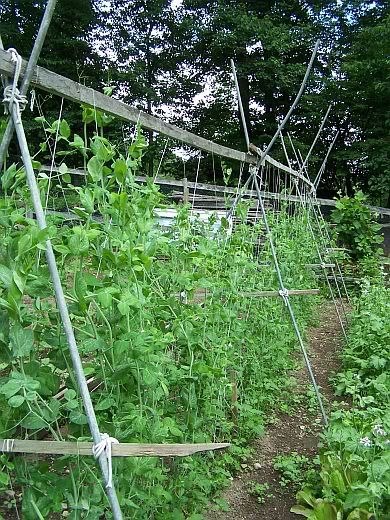
i'm happy with the pea trellis that i built this year, my peas are starting to set flower...it won't be long before there will be peas. the poles and the vines are taller than i am, and the trellis is holding strong in the high winds that accompany the thunderstorms. i'm growing a good crop of norli snowpeas, a dutch variety with a lovely purple blossom. my seed bank supply of this variety has been dwindling, so i'm hopeful about a good harvest.
Photobucket

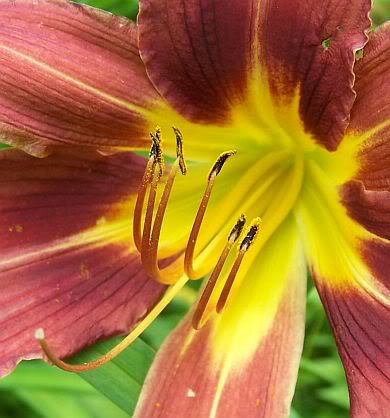
the daylilies are coming in, the reds...
Photobucket

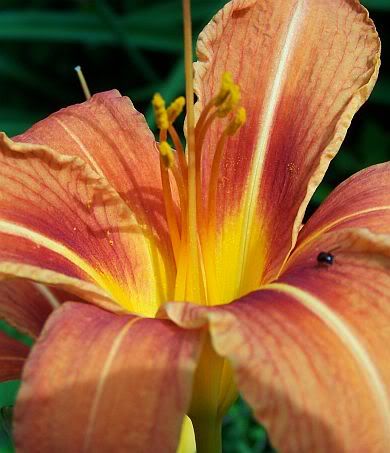
and the oranges...

Photobucket

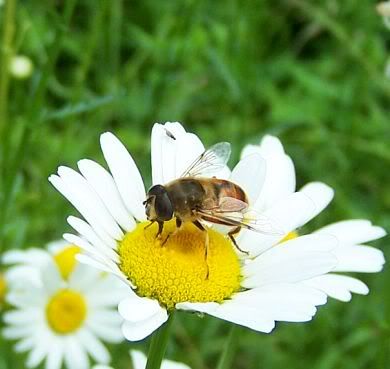
Leucanthemum vulgare, oxeye daisy....marguerite...moon daisy, dog daisy ...he loves me..he loves me not...they line the roadside where I walk

Photobucket

...by all accounts, he loves me.

Photobucket

beeflies amuse the eyes..."is it bee? is it a fly? it is a beefly." this one is a villa, i think.
Photobucket

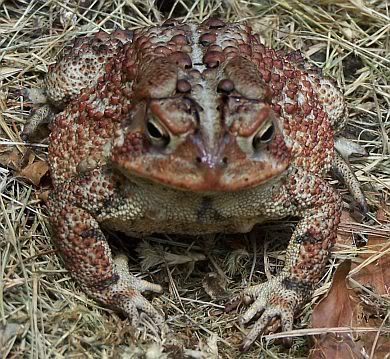
Bufo americanus lives here...eastern american toad... in her red phase...at least i think i should say "she"...the color of the throat may be darker if it was a he. size would also be an indication of the sex, with the females being larger than the males. this toad was easily the size of the palm of my hand.
Photobucket

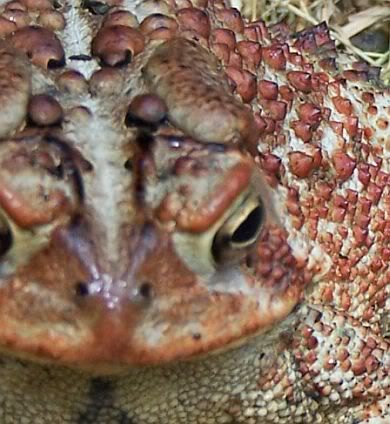
is it any wonder that some people think you can get warts from a toad?

while these warts may secrete a noxious milky bufotoxin, you cannot get warts from it....but i do remember reading that the native american indians from this area would use the toxic secretions to dip the tips of their arrows in. ouch!

the elderflowers from the black elderberry trees are everywhere! it will be a good summer for the berries, if all goes well, i will restock the shelves with jam and syrup and cordial. there are enough flowers this year to also pick for drying for tea. i don't care for the flavor by itself, but when mixed with lemon balm leaves and blackberry leaves etc. i will take some if needed for those winter colds or sore throats. elderflower wine (elderblow) is something i've never tasted, but i have heard that is is delicious and has a beautiful pale yellow color. other things like salves or oils or bath salts can also be made from the dried flowers. (always use caution with leaves or stems and seeds...those should not be ingested)

a walk through the garden leads me down the path and stops at the hillside where i can see and hear the river..although it beckons "come and swim", the water is still to cold for me to enjoy it...maybe by mid July...

Saturday, June 19, 2010

strength

I recommend going directly to Youtube and watching this video on a full screen so you can see all of the details . It is the best representation of "twiddling" that I have seen in action. "Twiddling" for lack of a better word- describes the technique he is using to spin the wool. Note the position of his fingers (two in front and thumb behind the spindle) and how he spins in an almost supported style, without any support for the spindle. Also note the how he is able to wind on to that large cop with ease. Imagine the strength and skill of his hands.

All the while, the smile never leaves his lips.

Tuesday, June 01, 2010

right on schedule

Photobucket

This years fawn makes an appearance today. Right on schedule. Seems you can set your clock by them. Memorial Day brings the fawns.

Photobucket

New born fawns are knee high to their mothers. So far, this one is coming around with mamma and another...yearling I think...the babysitter. The three of them are hanging together.

Photobucket

What a beautiful time of year to enter the world, with the roses and flags to great you...have a look at the fawn born last year..I'll wait.

Photobucket

Unfinished projects sit on the table with the roses..the scent is lovely. So fresh!

Photobucket

I'm almost ready to ply...on the spindles ... the last locks of Allspice (Alpaca), blended with cashmere. Work on woven stole is nearing completion....right on schedule...NOT!

Sunday, May 30, 2010

phenological events May 2010

phenological events

May 2010

1st bluetts and heal all
5th peas and lettuce up
10th tree swallows
11th frost overnight
15th cat birds arrive
plant potatoes
16th hummingbirds!
18th warblers!
19th pea trellis built
22nd planted string beans
29th red currents ripening
30th red raspberries setting fruit

Thursday, May 20, 2010

the shetland connection

Cathy is my Shetland Connection. Over the years, (has it really been years?) I occasionally get a package in the mail from her...little (and sometimes bigger) baggies...with bits of Shetland sheep fleece tucked inside. I spin them up, I make notes...I set them aside...in my "Shetland samples" basket.

Photobucket

The baggies are marked with the name of the sheep, and occasionally the name of shepherdess and/or the name of the Shetland color. According to the NASSA..Shetland wool comes in one of the widest ranges of colors of any breed.

While reading up on the names and numbers of colors that can come out of the Shetland breed, I found this interesting quote:

"Besides the white, the sheep produce several shades of wool including moorit(reddy/brown), shaela (silvery grey), fawn, grey, dark brown and black. They are often patterned such as krunet (white crown), katmoget (dark belly) and gulmoget (light underneath). There are 11 main colors as well as 30 markings, many still bearing their Shetland dialect names. Unfortunately, many of these colors and markings have become quite rare as white wool has historically commanded better prices."

Photobucket

I'm starting to enjoy seeing the range of samples that I am slowly amassing...they look so pretty all lined up.

From dark to light:

Batty Grey (which was my favorite!)
Ana-Dark
Henna
Liberty
Sax Emsket multicolor
Fawn
Korny
Liberty light
unmarked
Nikke
Peeps

Some samples have been spun on the Great Wheel, others on the Ashford, or CPW...and a few are spindle spun. Some are woolen, some are worsted, and some are somewhere in between. Some of my samples are singles.

I have tried to spin the individual wool samples the way I believe they should be spun. In other words, I spin the wool in a manner that I think the wool would best lend itself to make the type of yarn they were born to be. If you don't spin, you may not understand what I am talking about. That's OK.

I still have a few baggies stashed away to spin up...they are marked:

Islet
Truffles
Pelageo
Willow fawn
Myrtle
Sass

And what is to become of all this yarn?

Photobucket

Cathy has completed a Shetland Samples sweater...gorgeous..did you see it? And Leigh has also worked with Shetland samples...did you see her finished Shetland Sweater? Oh my! I just love looking at their work! Each sweater reflects the imagination and style of the creator. When I think of the talents and skill and creativity that went into these sweaters, I stand in awe of them!

Both of these projects are so beautiful, and inspirational...one of these days, I will finish spinning up my Shetland samples, and create a sweater of my own. But I don't mind telling you, after looking at these two projects, it is somewhat daunting to think of making my own!

Tuesday, May 11, 2010

fusul

There are so many things we can learn just from looking at pictures. Visual Language. Pictures can speak to us. ...you know....that expression about them being worth a thousand words.....

A minute into this video, note the dual purpose of the spinning wheel. It appears that the spinner is winding off the cop onto a winder that has been mounted on top of the wheel. She is turning the crank on the wheel to turn the winder. At closer examination of the winder -- it looks to me as if inverted hand spindles have been inserted into the holes of the arms on the winder...again, another dual purpose.

I find myself watching, looking, learning.

Friday, May 07, 2010

looking to the past

Photobucket

It is getting hard to find a good supplier of flax strick. Good quality flax strick should be bundled, with all of the flax measuring the full length of the plant. Generally, it is 30 to 36 inches in length. This full length is important when it comes to dressing a line distaff for spinning. A line distaff is for long line flax strick, or an uncut full length.

The image above contains an example of premium quality flax strick on the left, and poorer quality on the right. The color of the flax would indicate the retting method. But if you examine the photo, you might notice that the flax on the left is nicely prepared, and the fibers are not stuck together. There are no pieces of broken boon (or the woody outer waste portion of the flax stem). I had ordered this flax strick online, and when it arrived I was disappointed in the quality. I really should have sent it back. I can send it through the hackels and clean it, or scutch and swingle it..but a fair amount will be wasted, and I paid for line flax, not tow.

I am posting these two videos of flax processing for you to compare (for those that might be interested). One video shows the modern methods and the other shows the traditional methods. One thing that strikes me when I compare the two videos, is that in the traditional or old method of processing --the flax is handled by human hands a good deal of the time.

Do you think we have a finer product by means of the new methods, or the old?

I would like to wish everyone a Happy Mothers Day...and show you a photo of my Great-grandmother, whose hands planted, processed, and spun flax to linen...long ago, and far away.

Photobucket

Having now completed the process with my homegrown/handspun flax... I feel a sort of bond or a sense of sisterhood with her...and certainly a sense of appreciation for the skill and work involved in creating a good piece of linen.

Thursday, May 06, 2010

extra hours

Photobucket

Spring is now in full swing, everyone and everything feels it. The young cockerel announces it several times a day and the songbirds agree.

The oriels have arrived, and the American Redstarts are back as well. Catbirds are late this year, along with the hummers...and we have not had a sighting yet.

Photobucket

Some of the late spring perennials bloom, while others are fading already. The sister to the cockerel hides behind the Bleeding Heart blossoms.

Photobucket

I've been making a point to get the eggs out of the henhouse early each day. I have 2 broody hens who keep looking around for eggs to set on. One of the hens has been sitting on a billiard ball for 2 weeks now! As a result, I have to collect the eggs before they find them. Part of my routine includes checking the asparagus patch and picking a few spears to add to the zip lock bag in the fridge. It is a leisurely task that I enjoy, as it gives me time to notice new sprouts of peas and lettuce and radishes that were recently planted.

Photobucket

A birthday gift of this beautiful support spindle by Fred Hatton holds a blend of Alpaca and Cashmere that will become the edge of the pashmina shawl/scarf that I am working on. Support spindling is one of my favorite things to these days. When I get a spare moment, I sneak off with one...maybe over a second cup of coffee a little after sunrise...or after supper on the deck..just before sunset.

BTW..sunset is happening as late as 8PM. This gives us a full fourteen hours of daylight to enjoy. Good thing, because there is a ton of work to be done around here! And it leaves little time to spin.

Photobucket

However, with something as enjoyable as sitting down to relax with spindle, it is easy to squeeze in a few minutes somewhere during the day...and it is amazing how quickly all those moments turn into yards!

calling all fibers

Public service announcement: You can send your hair, pet hair, alpaca, sheeps wool etc. to help clean up the oil spill in the Gulf! Details can be found HERE

Saturday, May 01, 2010

april 2010 phenological events

1st frogs wake up with beards
2nd quince buds show color
5th carpenter bees and wasps
8th warblers return
12th oriels arrive
18th may apples open
22nd wrens build in nest boxes
28th transplant tomato plants in greenhouse
April 2009

1st- frogs seen growing beards
3rd- garden bonfire
8th- spot broccoli starts
12th - amphibian eggs in pools
15th- ruby-crowned kinglet
warbler migration begins
18th- caddis fly hatch on river
19th- toads in garden
wasps start building nests
21st- mayapples appear

april showers bring may...

apples!

Photobucket

Well, almost May Apple flowers...buds are bursting everywhere. May Apple is also known as American Mandrake...and Indian Apple...once I heard someone call it Racoonberry. I wonder if raccoons eat it, I've never seen any critters eating the May Apples, but they must be, I never see the fruit of these flowers. A friend of mine once remarked that May Apples were eaten by the Native Americans, but I believe the plant can be poisonous if you don't know how to prepare it. Certain parts of the plant should not be ingested! Seeds and rind of the fruit should never be eaten. I shall have to watch carefully to see if any wildlife eats the May Apples.

Photobucket

There are more apple blossoms in the garden, these are from my Whitney Crabapple tree. My tree is 4 years old now. The old timer who sold it to us called it a sheepsnose crab. I cannot remember if he told me the fruit or the blossom looked like a sheep's nose, and that is how they got their nick name.

Photobucket

We had to collect blossoms from other trees to put in the branches with the tree to assure pollination. Our other dwarf apple tree was destroyed over the winter by rabbits, or perhaps a porcupine, girdling the trunk. So sad to loose that tree, it was 2 years old. Judy brought me another up to take its place.

Photobucket

Work continues on the Alpaca/Pashmina "scawl". Scawl is my unword for a cross between a scarf and a shawl..

The Alpaca has been hand combed, then dizzed and spun to a lace weight yarn on the Great Wheel. The panels have been woven using the continuous strand method on a square loom. I am using a lace background stitch to connect the panels.

Photobucket

The yarn is so light and soft, it seems I am working with air. I will be interested in finding out what the total weight of this finished product will be. This is my second project from "Allspice" that has been designed for Paco Fino and Finca Alta Vista.

Wednesday, April 14, 2010

never a dull moment

Photobucket

My tomato seedlings are getting too big to live inside, it is time for them to make the move to the outdoor house....to the grow house, or home made greenhouse. My husband made a "house" out of "cast off" sliding glass doors. It serves as an over sized coldframe and is a great place to finish off plants before setting them out in the world to fend for themselves. Some critters (or maybe even the cat!) had been wintering over out there, and made a mess of things...pots were pushed over, trays upset..I had to do a big clean up before I could begin to pot the tomatoes. In the process of moving things, I uncovered this "resident" living in a six pack planter. Good thing I don't scare easily.

Photobucket

I carefully set the snake outside the greenhouse, so he could find a new home. I suggested the stone wall would be suitable. I told him to check it out, I would look the other way. But he seemed content to sit in the sun and enjoy the afternoon. Before long, the guard roo noticed him.

Photobucket

He sounded the alarm first (sounds like a horn honking call). He flapped his wings and knocked the six pack over. Then he used his, "I found something good to eat" cluck, and a few hens came by to check it out. They were not impressed.

Photobucket

Finally, they all wandered away... except for one Barred Rock hen, she stayed around and kept coming back to check on the snake. This one was just a bit too big to eat.

Photobucket

I finished up my work, and checked on the garter snake before walking back to the house, but he was still in the six pack. I guess it just isn't time for him to wake up yet. He didn't seem ready to find a new home.

Photobucket

Monday, April 12, 2010

forcynthias

Photobucket

The Forsythia is blooming. Forsythia is named in honor of William Forsyth, a Scottish botanist...but when I was a child, I thought that it bloomed for me..."forcynthia". Look at these blooming "forcynthia", I heard them say. (A touch of narcissism..)and more yellow.

The ones that bloom around the riverrim are 50 year old plants and older. The big bush shown above suffered during a late winter snowstorm when a branch fell from a tree above. Still, it flowers profusely in spite of the fact that the branch still weighs heavy on top of it.

Photobucket

At the advice of my sister, I took these cuttings for my window box in late February. There was still snow on the ground that day. I bundled the twigs and stuffed them in coffee cans filled with water. Surprisingly, even after the water has frozen and thawed several times over, the cuttings are now blooming...and I expect they may have rooted at well!

Photobucket

The Narcissus are blooming yellow too. There are two different origins, of how this plant got its name. One derivation is that they are named from the Greek word to grow numb..based on the narcotics contained in the bulb.

The other derivation is based in Mythology...

Photobucket

and this photo demonstrates the story beautifully!

Photobucket

I am working on several projects at once, and my worktable is cluttered, from left to right...bottom corner, silk/angora lace shawl, alpaca locks and combs, alpaca handspun being woven, plying of angora/silk on russian style support spindle (I worked the shawl as far as I could and then had to spin up more yarn...what a very bad habit!.....haven't I learned my lesson by this point in time!)

From my vantage point, I can gaze out the window and watch the yellow.

Tuesday, April 06, 2010

perfect imperfections

A few months ago, when there was snow on the ground, I was reading about the Knitted Lace of Estonia, by Nancy Bush. What a terrific book, the photos, the descriptions, the history...all of it is so interesting! Thanks to Grace, a knit-a-long was arranged, and I started my journey into learning some of the Estonian patterns and techniques.

Photobucket

Grace selected a smaller/ scarf version of the Queen Silvia Shawl for the KAL, and I followed the center panel (leaving out the gathered stitches and the lace edge). I worked the pattern in one direction. I was having so much fun knitting merrily along that I passed the mid-point and forgot the other side and the graft in the middle. There are imperfections, but I still like the way it turned out.

Photobucket

Most of my satisfaction was due to the lovely yarn that I was working with. 315 yards of "Zephyr" from Ball and Skein. Gorgeous Hand-Dyed Merino and Silk Lace Weight threads that slip through the fingers, and pour down from the size 3 needles. I had first intended to gift this yarn, as a yarn package...but I am very glad to have decided to knit with it and gift the finished object. It was a pleasure!

Captivated by lace, I begin to plan another project. This next lace work will be constructed from my handspun angora.

Photobucket

I have plied a single strand of angora with a single strand of silk. ..both singles have been spun on the Russian Style support spindle. There was not much information available to me on how to ply the singles onto the support spindle. From what I could gather, a plying card or disk is used to hold the singles that are first wound together. A found tea box is used in place of a disk. I had to reverse my hands for plying, funny and odd to me that I just could not get my flick on for a z twist with my right hand- so I switched over to using my left hand.

Photobucket

I'm sure I could have created a yarn with a better ply if I had used a suspended spindle to do the job, but I wanted to stretch my skills. Sometimes the best way to do that is to embrace the imperfections!

Sunday, April 04, 2010

time flows by

And spring is arriving along the riverrim. The above video captures the Thames River in Canada, but it could well be the river that flows behind my cabin. When I first saw this time lapse version of the seasons changing on the river, I found it to be very beautiful. I still do!

The transformations that take place are subtle. As water flows by, it sculpts and changes the edges of the bank. So much water flowing by... The ebb and flow of life...

...the forest and the creatures are waking up, and the seasons turn again. One ends, another begins.

Wednesday, March 31, 2010

march 2010 phenological events

March 2010

1st river levels rise
due to 20+" snowfall
16th skunk cabbage opens
22nd first thunder storm
24th phoebe returns
26th start lettuce and tomato seeds
28th wood thrush returns

compare with;

March 2009

1st- start pepper seeds
3rd- titmice and chickadees sing
5th - start broccoli seeds
12th - insects & snowdrops up
14th - woodthrush arrives
18th - phoebe arrives

and March of 2008

1st - snow storm
6th - wood thrush
20th- fox sparrow
26th- eastern phoebe
27th- pepper seed germinates
28th- planted tomato seed
31st- garden bonfire

yep. March is for phoebes, and tomato seeds! So I can say it is a good idea to start my tomato seeds when I see the first phoebe return.

Monday, March 01, 2010

clara

I want to spend the day with Clara. There is always so much to learn.

Sunday, February 28, 2010

feb 2010 phenological events

Here are the notes for February of 2010

2nd six more weeks
3rd snow cover returns
12th porcupine returns
15th egg avalanche begins
23rd-26th big snowfall 20+ inches
28th-flock of bluebirds near bank

I've been collecting phenological notes for a few years now. It is interesting to go back over them and compare the results.

Here are the notes from February of 2009

6th- flocks of bluebirds
8th- 4 hens laying
9th- turkeys strut in the morning
20th- woodpeckers drilling
24th- porcupine still in hemlock
25th- snow cover off the garden
28th- frogs wake up

And the notes for February of 2008

1st - ice storm
11th - observed 26 eagles
in one area, 10-20 feet above
the river 13th - ice storm
23rd - 8" snow
25th - cutting blackberry canes
26th - observed 29 eagles
along river towpath

Blog Widget by LinkWithin