Thursday, July 31, 2008

phenological events July 2008

phenological events

July 2008

1st - Gypsy moth males appear
9th - Japanese beetles arrive
10th - Female Gypsy moth lays eggs
Day Lilies blooming
14th - harvesting snow peas and broccoli
16th - string beans set blossom
20th - squash sets blossom
22nd - Black bear spotted
28th - green frogs start singing in evenings
29th - Crabapples ripen

walk with me wednesday, the path

Photobucket Stargazer Lily

I have no photograph to show you of the large rattlesnake that was in the path. It was at least a yard long. It was fat. And it was on it's way to the river. The image of it is in my memory.

My walking partner suggested we kill it. I disagreed. It was in our path. When something is in your path, you must decide what to do. Do you remove it? (if you can...) Do you choose another path, go around it? (if you can....)Do you stand there, indecisive, and allow it to deal with you?

Life hands you some pretty difficult choices along the path...in my mind, it is all about how you choose to deal with what is in your path.

Photobucket Skipper

Rattlesnakes are protected around here. Besides the fact that I wouldn't go against the laws of the land, rattlesnakes have their place in the universe. Not wanting to upset the balance of the universe, I wanted to leave well enough alone.

Photobucket

Years ago, my walking partner and I came across another rattlesnake in our path. It shot venom at us...from six feet away. We did kill that one...rattlesnakes were not protected in those days.

Yesterday, the rattlesnake that was in our path, slithered away and into the weeds, on his own path...down to river. I figure, we are even now.

Monday, July 28, 2008

linum usitatissimum

It was a very good day, when I walked out into my garden and saw this...

Photobucket

My flax is beginning to flower. This year I am growing "Marylin" seed that I purchased from the Landis Valley Farm Museum. It is a Dutch variety. 100 days. Flax should be sown on the 100th day of the year, and harvested on the 200th. I was late getting mine in, so it will be late getting it out. I am relieved to finally see it begin to bloom. It has such a delicate flower...unassuming ....yet gorgeous in it's own right.

Photobucket

I planted my flax over by the corn patch this year. I sowed it thick, to avoid side branching. I am happy with the progress it is making...and hopeful about the harvest and processing.

I've grown flax before, but have not been successful with the retting process. A few years ago, I purchased a variety called "Veralin" from the Mannings Handweaving School, in Adams County Pennsylvania. Veralin is a variety from the Netherlands, and was bred in 1999 from the parents Torshok and Lidia (which I think are Russian varieties). It grew to maturity for harvest, but was very fragile, and did not ret well at all. It was good for fire tinder.

The seed I am raising this year, is far from the cultivar that my great grandmother grew. Commercial breeding of flax started around the end of the 19th century, it is being bred for the end user, and there are many legislative barriers in place surrounding the distribution.

Photobucket

There is one other variety that I have not tried, and it is available from Richters seed company. It goes by the name of Evelin, and I think it is a Dutch variety. If anyone has any other variety available ...or information as to where it can be purchased...please leave a comment or contact me in a private email. I would love to try an old variety if it were available. All the seed that is for sale these days is treated. An heirloom fiber flax seed would be very valuable.

Monday, July 21, 2008

the midsummer pause

The cicadas started to sing a few days ago...six weeks till frost.
Taking some time to pause, and notice summer in her finest moments...

Photobucket

This years fawn is sleek. Hard to tell if it is a buck or a doe yet. Is that a small bump I see at the base of the ear? Is it a buck?
The buckmoon is waning. Always a puzzler for me, buck moon..... seems like that should be during our hunting season, but if you think like a native American Indian, you will understand.

Photobucket

The bees carry yellow saddlebags of pollen. They remind me that I have to pack for a trip away from home.

Photobucket

In the morning, the pond lily opens...
and in the evening, it closes again... Photobucket

reminding me to notice the fullness of these midsummer days. If you don't pause to notice...you may miss something...

Photobucket

Friday, July 18, 2008

pisum sativum

Photobucket

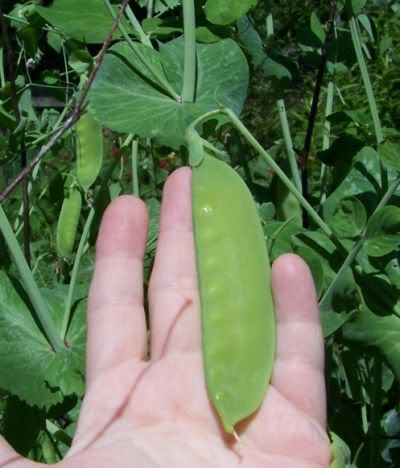
I've been wanting to tell you about my peas since I planted them this past April. I have been photographing them along the way...since they were few inches high. I am now harvesting them!

Almost ten years ago, there was a little seed company called Shepards Seeds. They were brought out by Whiteflower farm, and do not offer the same vegetable seed variety that they once did. I used to order from Shepards, and one year I brought a small packet of seed that was marked Norli.

The Norli is a nice snow pea, tall growing, with a purple flower. I saved the seed from it. I'm glad I did because I have had trouble finding the same seed in catalogues and I'm not sure why more growers don't carry it. The closest I can find is something called carouby de Maussane.

Anyway...this year I had decided to grow the Norli pea again, to replenish my seed bank which was getting low. I will enjoy some fresh picked for eating, but mainly this crop is for seed.
Photobucket

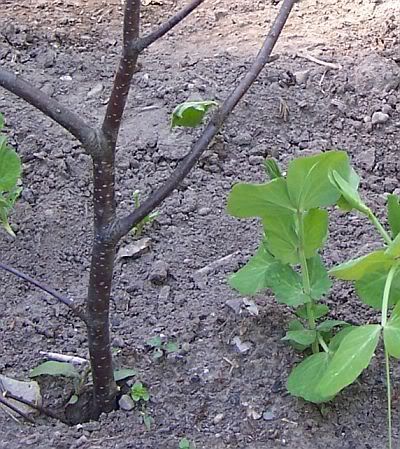
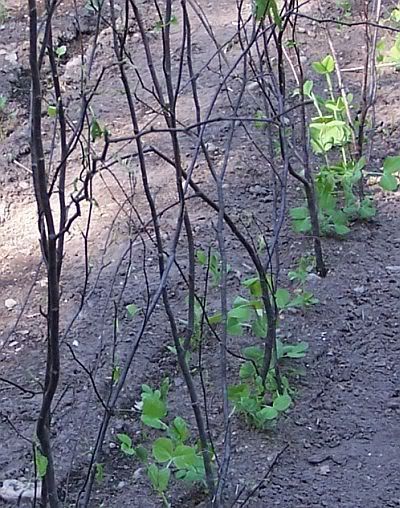
Because Norli is a tall vine, I needed supports. I take a walk in the early spring and find and collect branches from the river birch that have suffered from winter kill. I have used black nylon pea trellis that you can buy in the store...but I really don't like the way it looks, and I hate taking it down. With the branch method, I can pull up everything when the peas are finished out, and toss everything into the compost.
Photobucket

The branches are placed in the soil, next to the peas when they are about 2-3" tall.
Photobucket

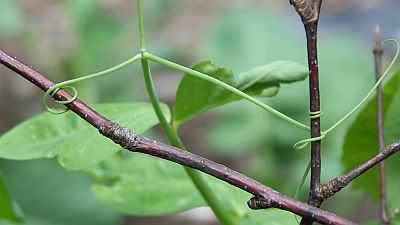
I don't even have to train the vines, the tendrils seem to know exactly what to do.
Photobucket

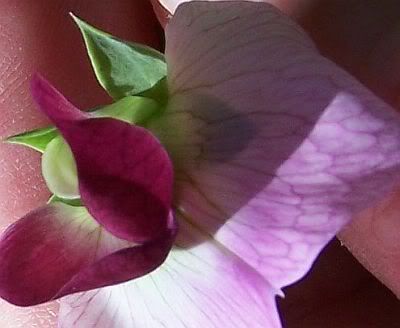
Pea flowers are amazing to me. They pollinate themselves. The pollination is complete before the flower opens. Bee-less.

Mendel used them as his specimen for his published work Experiments in Plant Hybridization.

I'm trying hard to understand the down side of the self pollination, which I think might be that sooner or later genetic errors will be passed down, and the plants will weaken. I figure I have planted at least the 4th generation of my Norli, and so far they look pretty good.

So, having now enjoyed the first harvest, I will pick with discretion, and save the rest for the bank.

Thursday, July 17, 2008

historical demonstration, or never a farby be

Photobucket

Last weekend, The Greene-Dreher Historical Society hosted an open house, and Grace Hatton and I were demonstrating and speaking about spinning, spinning wheels and general topics related to the craft.

Photobucket

It was the first time I "dressed" for an occasion. My ensemble included a pinner apron, and the Lacy Winged Shawl that I knit from linen.

I carried a authentic reticule, and wore a pair of antique spectacles that worked just fine. While doing some research on what I should wear... I was enlightened when I discovered that because my skirt and blouse and shoes were from the wrong century, I was deemed to be a "farby" in certain circles.

"No one really knows where the term "Farby" originated, but most people believe it started when "thread-counters" (ultra hard-core reenactors who have an eye—and a mouth—for authenticity) would spy something wrong and say, "Far be it for me to say anything against what you are wearing, but that pin/brooch/fabric/plate/whatever is not period (i.e, correct) for the early 1860s."

A salesgirl from a dress shop in Gettysburg emphasized to me that "no one wants to be called a farby." No matter, it was all for fun.

Photobucket

Grace wore a costume too. Her ensemble was less farby-ish. She is pictured here spinning on her Londonderry New Hampshire Wheel. What you cannot see from this photo is the beautiful petticoat she is wearing, along with a pair of pantaloons that she made.

I've enjoyed learning about period dress, and will continue to explore this area. There are many ways to learn, but the easiest is to just look at old photographs or paintings, and take note of the styles.

Photobucket

Soon after we had arrived, the secretary of the historical society informed us that there was a Great Wheel in the upstairs portion of the building. She was wondering if we would like to take a look at it.

Photobucket

It was a lovely wheel that was in very good condition. It had barrel tensioning, and a wheel head like I have never seen before. Fred noticed that the accelerating wheel had a wooden post on one side, and on the other, a metal thread with a bolt at the bottom that could adjust the head, much like the maidens on my wheel would. It was very interesting. If anyone else has seen a wheel head like this, I'd welcome your comments and any information you might have about it. It had no markings on it, but it looks to be a Denio wheel head.

Sunday, July 13, 2008

jellin'

It is tedious work, but finally the currents are picked and jarred.

Photobucket

It isn't as fine as Bar-le-duc jam...I don't have any spare goose quills with which to de seed my currents...so I smash 'um up with my potato smasher.

After a trip through the jelly bag, the sugar is added to the juice...(it is best if you warm your sugar first) ...and bring the mixture to a rolling boil for exactly one minute.

Pour, wipe rims, top with sterile lids and rings, and process in a hot water bath, for about ten minutes.

Photobucket

There was satisfaction today as I admired the translucent jars on the counter...there was also lip smacking of the taste tester.

Thursday, July 10, 2008

just for a day

Photobucket

The day lilies lined the roadsides all the way down to Gettysburg where we spent a few days over the holiday. They were also waiting for me in the garden when we returned home.

Photobucket

A hot spell, humid and still, has been replaced by breezy fresh air today. The day lily blooms with the bold oranges and reds, that catch my eye and hold it. I studied them.

Photobucket

At dawn, a bloom opens to catch the sun, captures it for a day...by nightfall the blossom withers.

Photobucket

As much as I am tempted to pick and eat them in soup or salads, the fleeting beauty convinces me to let the bloom stay on the stem.

Tuesday, July 01, 2008

fuchsia

Photobucket

A few weeks ago, we shared the company of a childhood friend, who had traveled East to help celebrate an anniversary of the elementary school that we had attended. Upon arrival, my husband was presented with the very thoughtful gift of a Fuchsia. (more about my gift at a later date).

We have never owned a Fuchsia before, though both of our respective mothers had. We talked about how we had always admired them, but had heard that they can be "fussy"...requiring special conditions in order keep looking as spectacular as they did when you first purchased them.

Photobucket

I have heard them called Lady's Eardrops or Dancing Ladies. It is easy to use your imagination and understand why. In the past few weeks we have pampered it, and it seems happy to enjoy the cool mountain air, as well as the humid nights along the riverrim.

Photobucket

I have been spinning a braid of Wensleydale roving that I purchased at Rhinebeck last October. It had a tag on it that read "Cranberry". "Deep Fuchsia" would be a more appropriate name for the colorway....or "5RP" according to Munsell. ...wouldn't you agree??

Photobucket

Did you know that Crayola replaced the name "Violet Blue" with "Fuchsia" in 1990?? I didn't. For years I thought that violet blue was my favorite crayon color...now I can answer "deep fuchsia" when someone asks...btw...what is your favorite crayola color??

Monday, June 30, 2008

june 2008 phenological report

phenological events

June 2008

1st - Blackberry flower sets
2nd - planted corn
Hellgrammites pupate
3rd - planted beans
scarlet tanager
4th - cahills hatch
red belly snake
gypsy moth caterpillars
numerous
eastern milk snake
5th - flax germinates
9th - wax wings build in oak
11th - corn germinates
14th - second plant beans
15th - whitetail fawn
24th - elder in bloom
viper bugloss, butter&eggs
27th- gypsy moth pupate

Wednesday, June 25, 2008

walk with me wednesday, watching for waxwings

The cedar waxwings are one of the last birds to build a nest around the riverrim. They dine on fruits and insects, so they raise their young in time to coincide with the bounty that mid summer provides. They sometimes nest in colonies. My husband has noticed that there are two nests in our oak tree near the river. We go walking in the early evening to look for more.

Photobucket

We notice the elderflower, the butter and eggs, and the viper's bugloss starting to bloom. We meet this years fawn...

Photobucket

it is curious, and lags behind it's mother to get a closer look at us, but not too close...fright gets the best of it, (as well it should!) and it runs to catch up with the others.

Photobucket

The sun is starting to slide down the other side of the mountain, early evening is an active time. The birds are busy getting a meal. They gather together to roost, and sing the sun down. We don't see any waxwings, but we do see frogs...

Photobucket

finally, just as the light is fading, we see one. I love the mask they wear. The waxwing is on the right...their moss lined nest is hidden...can you see it on the left of the photograph?

Photobucket

Monday, June 23, 2008

new cria

On Friday, late afternoon,I had a chance to go down river and see a cria who was just one week old. For those who are not familiar with the word, a cria (cree-ah) is a baby Alpaca.

Photobucket

Meet Isabella...(KIMBERLEE'S RC (RIVER COUNTRY) ISABELLA ). She belongs to my friend Louise of Kuhn's River Country Alpacas and they are very happy to welcome her to their world (er- herd).

Photobucket

Here is photo of Isabella with her mama.

Photobucket

The proud mama's name is Kimberlee. There was also another family member nearby...

Photobucket

this is her step sister, Sassy... They are all members of the biological family known as Camelidae.

Isabella is a real cutie. She makes funny little noises. Her vocalizations seem to be a combination of mewing and baaing with a sort of humming that would change in pitch from time to time. If you have ever played the kazoo, or comb & paper, it sounds a bit like that. I wondered what she was saying in Alpaca language.

Photobucket

I have never met a baby alpaca. For someone who is so small, she made a big impression on me. Isn't her color grand? I dream about the nice rich and luxurious fleece she will produce, resilient and strong....having a natural silky luster...with a nice long staple, maybe an excellent crimp and maybe possessing a micron count of say 21-22....that can be spun either worsted or woolen..that can be knit or woven ...having a soft handle...

In a word, it is what we spinners like to refer to as- YUMMY.

Thursday, June 19, 2008

trying not to loose

Photobucket

This time of year the garden gets invaded. It is amazing to see how many life forms want a piece of it. It is a battle trying to raise things, and protect them from the many forces of destruction. I don't like to interfere too much...I like to let nature take her course and decide what will be-- most times. But enough is enough.

I've had to plant my corn and beans twice this year. The chipmunks have stolen the first planting...leaving me with 3 bean plants and about a dozen corn plants. The only method that works for me is to cover the seed with my clay pots until they germinate and set leaf. I check the plants and uncover them when I am out working in the garden. Once they are about 2 inches high, they no longer interest the chipmunks, and I can remove the pots.

Photobucket

Most of my methods involve hand removal of a pest. The gypsy moth caterpillars are almost as big as my fingers, and I have to wear gloves to remove them- ugh. I try to erect barriers in those places that I cannot reach. They are very bad this year, mostly defoliating my largest oaks. The loss of sunlight on the leaves is costly, serious...and sad.

Photobucket

The striped cucumber beetle has arrived and is busy in my potato patch. It is not so much the damage they do (chewing the leaves), my squash is infected with the bacterial virus that they spread. Hand removal works best with these also. The best time to catch them is when they are- ahem- engaged.

If I hold a small bucket of soapy water beneath them, I can shake the leaf they are on,and they fall right in. It is also a good time to check the underside of the leaves for eggs of potato beatles and eliminate the next generation.

Photobucket

Is it worth all this effort? The constant vigilance... ...sometimes one gets weary of the battle...but I think of the harvest.

Tuesday, June 17, 2008

passing through

Photobucket

I've been working with a Rambouillet/Karakul sample that I received from Cathy, ah...I don't remember when. (I really need to start taking better notes.) It was already washed, so I just teased it out.

Photobucket

Spun on the Ashford Traditional..supported long draw....forgot to check the ratio. I was curious to find out the yardage of my singles.

Photobucket

Wound off onto the nod (which seemed to take for-evv-vah)!

Photobucket

but wound up to be eight-hundred and something or other yards of thread that passed through between my thumb and index fingers.

Photobucket

...and weighed in at a little over 5 ounces.

Photobucket

I kept a sample for my notebook. These little cards and envelopes are great for slipping a lock and a bit of spun yarn into....along with my incomplete notes on the reverse side.

Blog Widget by LinkWithin